Whilst incredible when done correctly, a lot of games run into trouble when asked to tell a story in their experience, often taking control away from the player during these moments and separating the two with a very clear divide. In this article, I wish to explore a couple games that fall prey to this, and some recent examples of games hitting the nail on the head.
I could draw examples from the entire Final Fantasy franchise, however I wish to focus on Final Fantasy 7 for its fame. Final Fantasy 7 has an amazing story, with beautifully written characters, and fantastic twist's and turns in the narrative. However you could cut the RPG out of the game, throw some actors at it and turn it into a film, and you would by all accounts have the same experience. Combat is constantly separated from the rest of the game, exploring the world is primarily about loot acquisition. There is some story and development tied into the vignette's, stage setup and triggered event's, but a flaw with the game is the severe lack of interactive story telling for a video game.
I would compare this to another RPG, one with a significantly weaker story, in Pokémon. Story in Pokémon games traditionally is near nonexistent. There are 2 story lines in every game intertwined, one where the evil organisation (Team Rocket, Team Magma, Team Skull, etc.) Is chasing after a powerful Pokémon with evil intent. And the other story is the protagonist becoming a Pokémon master. No tragedy bi real character development. (though this has improved with more recent games,) yet the story matches the mechanics near perfectly. Becoming a Pokémon master is about overcoming obstacles, filling the Pokédex, and your Pokémon growing up, something well represented by the focus on the leveling up mechanics and Pokémon catching mechanics over all else.
Another comparison that could be made, would be comparing FPS games Spec ops: The Line, to Destiny. Both amazing games, but there is a very real argument to be made that Destiny doesn't represent it's story at all good enough in it's gameplay. They focused on making the game enjoyable first, then slotted a story around it later on down the pipeline. The story is pretty weak, doesn't fit particularly well, just like it's soundtrack. If you were to experience these separately from a game format, it would be amazing, as a novella or a film. However as a game, there's very little reason given why we are doing what we are doing in the game. There is a lot of story in Destiny, but it's all situated outside the game. It happened in the past, it's recorded on some website, rather than represented in large in the full game. And while this isn't inherently a bad thing, see League of Legends for example, it's a tool that doesn't fit every game. And a game that has a clear beginning, middle and end, has plenty of ways of utilising this storytelling technique.
Spec Ops: The Line as juxtaposition, is a game praised for it's beautiful story, Without any spoiler's, they have taken very heavy theme's about war, dark dangerous storyline s for a dark dangerous job shooting enemy forces. It's a very fitting game for the emotions they wanted to evoke in the player, what better game to explore the minds of war, than a first person shooter? The characters are very real, they have a lot of emotion, a lot of expression. A far cry from other FPS games where you mow down a hundred soldiers without thinking twice, Spec Ops: The Line is a game that straight up wouldn't work as any other genre of game.
I of course don't mean to suggest that there is only one perfect story to be told by each genre, that each game needs to perfectly encapsulate it's story through gameplay mechanics, I don't mean that at all. Some games can absolutely decide to prioritise making the gameplay good, then introducing story and character at a later date. Recent multiplayer only games Overwatch and League of Legends are perfect examples of this, where there is mountains of story for players to engross themselves in, but that don't get shown at all in the actual game. You could have never played them before, and just by poring over the pages and pages of League of Legends lore and developing content, you can get a grasp for the story behind the world. By watching Overwatch's animated shorts, reading their comics, their short stories, you can absolutely discover the story behind the scene's of the game, story that ultimately has very little impact on the actual multiplayer aspect of them. I also feel like the gameplay itself is vastly improved, because they never have to consider what story might become wrong if they make a big change.
To conclude, I think there is a lot of important discussion to be had around this topic. Whether we should anchor our idea's to the game genre (or the other way around), whether we do the opposite and ignore it, or where that sweetspot in the middle actually lies. Whether it's best to focus on story or gameplay is certainly a question with no easy answer. Some will prefer it one way, others another, it really comes down to a point of personal preference.
19 October 2017

27 September 2017
The Indie Game charm.
Indie games and their developers can be a very interesting point of discussion. When considering how much games cost to make, how huge a task it can be, you'd think it near impossible for a couple blokes in a basement be able to make a whole game in a few years, comparing it to film making which is arguably easier, you wouldn't dream of making a whole 90 minute feature film all by yourself, yet somehow games developers make it work with blood sweat and tears. They garner pretty huge fanbases too, there are some people who will bend over backwards for new indie developers, but won't give the time of day to published titles. While somewhat more controversial for many reason's, We Happy Few, previously a little indie survival game is receiving criticism because they were just acquired by a big name publisher. (more details here, it's not just publishing issues.) In this article, I want to touch on some of the things that make indie games tick, and why they have earned this reputation.
One of the most instantly recognisable traits of indie games, is the lack of photo-realistic graphics. They don't have the time, money or manpower to create that kind of product, it's a simply problem though, you just have to look outside the box to make the game still look and play good, with as few resources as possible. We call these, stylised graphics. They will still have detail in them, but they will limit it and allow their scene's to be simpler and let the players imagination take over more. Games like Salt and Sanctuary get through with simple 2D animation, games like Gone Home have used a lack of bump mapping, simple models, and modest textures to create a flatter image from scene to scene, and tried to keep it clean so you didn't focus too hard on the lack of graphical fidelity the game settled with. The decision to use simpler techniques early on and work with them, is an intelligent decision because you don't need these extra techniques to make a game look good, a good artist can make amazing things with just a single permanent marker, if they know what their tool's are capable of. While they might get better results with more advanced techniques and equipment, they don't chase after that impossibility and focus on doing the best with what is in front of them.
Majority of these games also try to keep their games short, sweet and too the point. This is another one of the indie games limitations, they don't have the money or manpower to make a game on the scale of say Metal Gear Solid, or Elder Scroll's. The don't have the team to build that kind of game, so they have to settle for something smaller. This isn't always a bad thing though, because with smaller projects you can give more due care and attention to every individual part of the game, than you ever could making a Battlefield or Call of Duty sized game. You have the liberty of play-testing the entire game not just for bugs, but for quality. You get to ensure that every line of dialogue a character says fits them, you get to ensure that every side-quest is a value add to the game, or that every encounter, puzzle, or event is worthwhile.
A game I played recently is a very good case refering to this. Mages of Mystralia, a little adventure/puzzle game, is a game simply brimming with character and thought. Even nobody NPC's you talk to have some sort of personality, the world itself is packed with minute little details and information. Such example's I noticed were all of the headstones in a cemetary having unique writing on them. One of them was related to the story, "This one seem's to have been freshly dug." "..." which held a lot of story significance, It was refering to the protagonist's uncle dying to her actions at the beginning of the game. Others would be the little scars the protagonist's actions leave on the world. You burned down an evil tree spirit, you can see where they died scorched into the ground. These little details are something that's easy to miss in a game the scale of Elder Scroll's, though they try their best, you simply can't get to all of it with the same level of care, and they are essential for building a world, turning a level from a part of the game, to a real believable place.
There are hundreds of examples of this amongst indie games, Undertale springs instantly to mind as a game that just didn't stop at a one word answer. Every character in the game has a personality, even some of the near nameless enemies have personality and character. Salt and Sanctuary, they had the liberty of extensively play testing and improving the game systems, well past when the game was "finished". Because the game is somewhat smaller with simpler graphics and a simpler engine, it is a lot more manageable of a task to develop where the game was lacking. These are a little bit dated, but PopCap games' work in Peggle and Plants vs Zombies did this too. They started with really simple idea's, but instead of leaving it just black and white, they spent time fleshing out wacky and wonderful characters to inhabit it.
There is one game however, that I want to mention not because it possesses this trait and uses it well, but rather because they specifically decided against that. Hellblade, Senua's Sacrifice completely breaks this mold, they decided it was more important for the game to focus more on the technical side of things, making sure the gameplay is good, making the graphics are as high quality as possible and avoiding a stylised art style. You could tell that indie charm wasn't on their agenda, they wanted to provide a different kind've experience that that. Still an amazing game regardless from what I know, but for different reason's.
Indie games are an interesting subject, I think it's amazing that they knew they couldn't beat the big developers at their own game, so they found their own little niche's and slipped through the cracks to gamers publishers just can't reach. It's certainly important that both exist (even if publishers have been commiting suicide recently with these PR moves and "money is everything" attitude) because there are some games that little indie companies will certainly struggle creating. I mentioned Hellblade earlier, but I consider that an outlier from a seriously talented team, and not everyone can follow Ninja Theory's footsteps. Some of the problems development teams face, is just simply not being able to pay their workforce to finish the game by the deadline, something a multi million dollar company just so happens to be useful for.
One of the most instantly recognisable traits of indie games, is the lack of photo-realistic graphics. They don't have the time, money or manpower to create that kind of product, it's a simply problem though, you just have to look outside the box to make the game still look and play good, with as few resources as possible. We call these, stylised graphics. They will still have detail in them, but they will limit it and allow their scene's to be simpler and let the players imagination take over more. Games like Salt and Sanctuary get through with simple 2D animation, games like Gone Home have used a lack of bump mapping, simple models, and modest textures to create a flatter image from scene to scene, and tried to keep it clean so you didn't focus too hard on the lack of graphical fidelity the game settled with. The decision to use simpler techniques early on and work with them, is an intelligent decision because you don't need these extra techniques to make a game look good, a good artist can make amazing things with just a single permanent marker, if they know what their tool's are capable of. While they might get better results with more advanced techniques and equipment, they don't chase after that impossibility and focus on doing the best with what is in front of them.
Majority of these games also try to keep their games short, sweet and too the point. This is another one of the indie games limitations, they don't have the money or manpower to make a game on the scale of say Metal Gear Solid, or Elder Scroll's. The don't have the team to build that kind of game, so they have to settle for something smaller. This isn't always a bad thing though, because with smaller projects you can give more due care and attention to every individual part of the game, than you ever could making a Battlefield or Call of Duty sized game. You have the liberty of play-testing the entire game not just for bugs, but for quality. You get to ensure that every line of dialogue a character says fits them, you get to ensure that every side-quest is a value add to the game, or that every encounter, puzzle, or event is worthwhile.
A game I played recently is a very good case refering to this. Mages of Mystralia, a little adventure/puzzle game, is a game simply brimming with character and thought. Even nobody NPC's you talk to have some sort of personality, the world itself is packed with minute little details and information. Such example's I noticed were all of the headstones in a cemetary having unique writing on them. One of them was related to the story, "This one seem's to have been freshly dug." "..." which held a lot of story significance, It was refering to the protagonist's uncle dying to her actions at the beginning of the game. Others would be the little scars the protagonist's actions leave on the world. You burned down an evil tree spirit, you can see where they died scorched into the ground. These little details are something that's easy to miss in a game the scale of Elder Scroll's, though they try their best, you simply can't get to all of it with the same level of care, and they are essential for building a world, turning a level from a part of the game, to a real believable place.
There are hundreds of examples of this amongst indie games, Undertale springs instantly to mind as a game that just didn't stop at a one word answer. Every character in the game has a personality, even some of the near nameless enemies have personality and character. Salt and Sanctuary, they had the liberty of extensively play testing and improving the game systems, well past when the game was "finished". Because the game is somewhat smaller with simpler graphics and a simpler engine, it is a lot more manageable of a task to develop where the game was lacking. These are a little bit dated, but PopCap games' work in Peggle and Plants vs Zombies did this too. They started with really simple idea's, but instead of leaving it just black and white, they spent time fleshing out wacky and wonderful characters to inhabit it.
There is one game however, that I want to mention not because it possesses this trait and uses it well, but rather because they specifically decided against that. Hellblade, Senua's Sacrifice completely breaks this mold, they decided it was more important for the game to focus more on the technical side of things, making sure the gameplay is good, making the graphics are as high quality as possible and avoiding a stylised art style. You could tell that indie charm wasn't on their agenda, they wanted to provide a different kind've experience that that. Still an amazing game regardless from what I know, but for different reason's.
Indie games are an interesting subject, I think it's amazing that they knew they couldn't beat the big developers at their own game, so they found their own little niche's and slipped through the cracks to gamers publishers just can't reach. It's certainly important that both exist (even if publishers have been commiting suicide recently with these PR moves and "money is everything" attitude) because there are some games that little indie companies will certainly struggle creating. I mentioned Hellblade earlier, but I consider that an outlier from a seriously talented team, and not everyone can follow Ninja Theory's footsteps. Some of the problems development teams face, is just simply not being able to pay their workforce to finish the game by the deadline, something a multi million dollar company just so happens to be useful for.
23 August 2017
My experience with Esports
When I was younger, I never thought myself the sporty type. I didn't enjoy football or cricket, sure I'll join in with friends for and hour and a bit, usually stay in goal, usually miss, didn't really care a whole lot as I didn't take it seriously. It was nice to just hang out with friends and chat about whatever. First to drop out so others can join in, not so much out of charity, it was just more important to them than it was to me. But despite my lack of interest with the sport I still held my first professional match with high regard. I went with my dad, he bought the three of us (him me and my little brother) tickets, we found our seats and bought a can of coke, and even though I didn't know the rules of proper football, I knew 100% what was going on at all times. There was a certain energy at the event that hooks you in, an amazing feeling. Thousands of people surrounding you, all experiencing the same euphoria, when the ball gets close to the goal. It's a simply amazing feeling, one you kinda have to experience to understand. I didn't follow football after that, I'll keep an eye on England at the world cup but the premier league I just couldn't care less about. However, that wasn't the end of sports for me as a whole...
In 2012, 5 and a bit years ago, I discovered the game League of Legends. The game was fun, I enjoyed playing it, but I didn't fully understand it at the time. So I was looking online for any better players who I could learn from, it was from there I found out there were professional leagues for the game, E-sports. I was surprised, I hadn't even thought about them before, that there could be tournaments for it, nevermind one's well broadcast online. Maybe for fighting games or Starcraft: Broodwar, but somehow I thought LoL just wasn't there. I watched a bunch of games that week, followed the event that was going on at the time. The name TSM was being cheered by fans in every single games regardless of whether they were playing or not, the name stuck with me. I seen them play later that event and found out they were from America, this further interested me, helped me relate to them as a team. And the final nail in the coffin, the thing that sealed me as a TSM fan from then on out, I seen this video. In this I seen the team I had just been cheering for at their deepest, most intimate level. I had just seen more than a player, I seen a human being with thoughts and emotions, crying over his teammate and friend having to leave. This really hit home for me, my heard went out to Dyrus, and I wanted him to succeed, wanted him to be happy. I had found my player, found my team, and after following them for a while I started to know more and more about the rest of the team. I did my research into the team, looked for any media I could find on them. Team video's, interviews, articles on them, articles by them, I wanted to know more, and with each snippet of information, I felt myself growing closer to them. During close matches, I felt that same sense of euphoria watching live, as I did when I was at that football match oh so long ago now.
The first roster change I didn't really have long enough to get to know Chaox, the person in the video before, so the team as I new it was already using his replacement. The first roster swap we had to make since then was the owner of the team leaving to focus on management, which majority of the fans couldn't be happier about. Reginald, the mid at the time, was a total douchebag. He was constantly was constantly a bad influence on the team, and constantly starting beef with the other players to big himself up. He was a very emotional character who everyone was happy to see replaced, him stepping down and getting replaced definately made later transitions easier to swallow, however every time it happened I still thought of Dyrus, hoped he dealt with it ok and wasn't too heartbroken. I liked the old team members and still check up on them every now and again, pop in Odd One's stream every once in a while, but I was comfortable moving forward with new players and new teammates who I grew to love just as much over time, especially the 2014 season team with Dyrus, Amazing, Bjergsen, Wildturtle and Lustboy. I felt that year was when TSM was really at their peak, if they were going places, it was with that roster, and they won a lot of events they attended, however all great things must come to an end. Come the end of the 2015 season, there was a lot of changes made to the team, nearly a full restructure. With Dyrus retiring, Amazing already left and his replacement was being benched, Wildturtle was replaced, LustBoy and coach Locodoco went back to Korea for a while. The team that I loved for so long was essentially disbanding, my favorite player was retiring from the scene for good, during his final interview on stage, I legit broke into tears. (Hell, even watching it back today 2 years later, I can't help but choke up a little bit.) I still love TSM today, though it's not quite the same. I still want the team I've cheered on all this time to succeed, but if a player get's benched or retires, I'm not gonna bawl my eye's out this time around.
I was fairly new to the competitive smash scene a few years after it had first really taken off. I'd always played the game, and already knew something was starting, but didn't really have an introduction into the scene until much later. When they were first starting out, it was only American's and Japanese who played it seriously, Europe didn't host tournaments at all, and we didn't have any way of actually keeping up with it unless you were already there, there was no youtube, no twitch, we didn't even have proper capture techniques at the time, games were filmed on phone camera's, and even then only rarely. The only way to keep up with the scene was the Smash Boards website a little unknown forum where people would post about their little underground tournament they were hosting over at Matts house. However as time and technology went on, I started to learn a bit more about it and with the release of The Smash Brothers a documentary about the history of competitive smash, I started enjoying it more and more, becoming more interested in the tournament side of things, rather than just being a player who enjoyed playing for fun with friends. The whole scene is still fairly fresh to me, still very exciting and new. I'm still learning a lot of the names of top contenders, though there are some names I recognise from past events or The Smash Brothers I mentioned before. I'm eager to see where the sport will be a year or two from now, see if it's still the same game I'm enjoying today, sincerely I hope it is.
Esports surprised me, as I said I never thought myself to be the sporty type. But within some of these online leagues and tournaments, I found a scene I could follow, a scene that has had me love and lose with my team, my players. THAT! Is my experience, with Esports.
In 2012, 5 and a bit years ago, I discovered the game League of Legends. The game was fun, I enjoyed playing it, but I didn't fully understand it at the time. So I was looking online for any better players who I could learn from, it was from there I found out there were professional leagues for the game, E-sports. I was surprised, I hadn't even thought about them before, that there could be tournaments for it, nevermind one's well broadcast online. Maybe for fighting games or Starcraft: Broodwar, but somehow I thought LoL just wasn't there. I watched a bunch of games that week, followed the event that was going on at the time. The name TSM was being cheered by fans in every single games regardless of whether they were playing or not, the name stuck with me. I seen them play later that event and found out they were from America, this further interested me, helped me relate to them as a team. And the final nail in the coffin, the thing that sealed me as a TSM fan from then on out, I seen this video. In this I seen the team I had just been cheering for at their deepest, most intimate level. I had just seen more than a player, I seen a human being with thoughts and emotions, crying over his teammate and friend having to leave. This really hit home for me, my heard went out to Dyrus, and I wanted him to succeed, wanted him to be happy. I had found my player, found my team, and after following them for a while I started to know more and more about the rest of the team. I did my research into the team, looked for any media I could find on them. Team video's, interviews, articles on them, articles by them, I wanted to know more, and with each snippet of information, I felt myself growing closer to them. During close matches, I felt that same sense of euphoria watching live, as I did when I was at that football match oh so long ago now.
The first roster change I didn't really have long enough to get to know Chaox, the person in the video before, so the team as I new it was already using his replacement. The first roster swap we had to make since then was the owner of the team leaving to focus on management, which majority of the fans couldn't be happier about. Reginald, the mid at the time, was a total douchebag. He was constantly was constantly a bad influence on the team, and constantly starting beef with the other players to big himself up. He was a very emotional character who everyone was happy to see replaced, him stepping down and getting replaced definately made later transitions easier to swallow, however every time it happened I still thought of Dyrus, hoped he dealt with it ok and wasn't too heartbroken. I liked the old team members and still check up on them every now and again, pop in Odd One's stream every once in a while, but I was comfortable moving forward with new players and new teammates who I grew to love just as much over time, especially the 2014 season team with Dyrus, Amazing, Bjergsen, Wildturtle and Lustboy. I felt that year was when TSM was really at their peak, if they were going places, it was with that roster, and they won a lot of events they attended, however all great things must come to an end. Come the end of the 2015 season, there was a lot of changes made to the team, nearly a full restructure. With Dyrus retiring, Amazing already left and his replacement was being benched, Wildturtle was replaced, LustBoy and coach Locodoco went back to Korea for a while. The team that I loved for so long was essentially disbanding, my favorite player was retiring from the scene for good, during his final interview on stage, I legit broke into tears. (Hell, even watching it back today 2 years later, I can't help but choke up a little bit.) I still love TSM today, though it's not quite the same. I still want the team I've cheered on all this time to succeed, but if a player get's benched or retires, I'm not gonna bawl my eye's out this time around.
I was fairly new to the competitive smash scene a few years after it had first really taken off. I'd always played the game, and already knew something was starting, but didn't really have an introduction into the scene until much later. When they were first starting out, it was only American's and Japanese who played it seriously, Europe didn't host tournaments at all, and we didn't have any way of actually keeping up with it unless you were already there, there was no youtube, no twitch, we didn't even have proper capture techniques at the time, games were filmed on phone camera's, and even then only rarely. The only way to keep up with the scene was the Smash Boards website a little unknown forum where people would post about their little underground tournament they were hosting over at Matts house. However as time and technology went on, I started to learn a bit more about it and with the release of The Smash Brothers a documentary about the history of competitive smash, I started enjoying it more and more, becoming more interested in the tournament side of things, rather than just being a player who enjoyed playing for fun with friends. The whole scene is still fairly fresh to me, still very exciting and new. I'm still learning a lot of the names of top contenders, though there are some names I recognise from past events or The Smash Brothers I mentioned before. I'm eager to see where the sport will be a year or two from now, see if it's still the same game I'm enjoying today, sincerely I hope it is.
Esports surprised me, as I said I never thought myself to be the sporty type. But within some of these online leagues and tournaments, I found a scene I could follow, a scene that has had me love and lose with my team, my players. THAT! Is my experience, with Esports.
6 August 2017
Learning League of Legends with different champions
League of Legends has long been regarded a really difficult game to get into. It is thought to have very little in way of a tutorial, and you'd be right to think that. While there is a brief tutorial, it isn't very deep. It cover's the absolute basic's of League of Legends, the rules you have to follow, and that's all. The rest is up to the player to figure out. This can be a problem because you don't necessarily know what you're doing when you first start playing, a lot of new player's feel like they don't get taught what tool's they have available to them throughout a game, often relying on 3rd party content creators to teach them, or friends who already play to coach them. In this article, I wish to tackle this misconception, and introduce the League of Legend's method of teaching game mechanics to a player, and how other game's could learn from this.
The genius behind this game, is that they introduced character's specifically for learning about these new tool's, and encouraging the player to practice using them to garner an advantage. I will be talking about 5 characters specifically, Cho'Gath, Kindred, Veigar, Shen and Teemo. I have chosen these characters, because they all have unique abilities, that push player's to trying new things or perfect essential skills in order to utilise properly.
Cho'Gath is a Jungle Champion, who's ultimate ability deal's extremely high damage to a nearby target, more so if the target happens to be a Jungle Monster. He is encouraged to save this ability for the final blow, because if he does so, he get's a small health boost. Due to his Tank role, this is very important to him and something the player will want to do whenever possible, however it also subconsciously teaches players to better secure neutral objective's, because the only thing that matter's is who gets that killing blow. As the Jungler has access to the Smite ability, that responsibility lies to them, it is a crucial skill to learn, and one that Cho'Gath really help's people learn about.
Another Jungle champion, Kindred, is a champion who specialises in playing aggressively in their opponent's jungle, because of their Passive ability, Mark of the Kindred. This is a rather complicated ability, periodically it will mark your opposing junglers resources, if they manage to steal those resources their combat effectiveness goes up. This is very a powerful but very risky strategy, by extending deep into enemy territory, if you get caught in a bad position, you're going to be in a lot of trouble. However you still want to utilise this ability, it gives you a lot of bonus's that you don't want to pass up on, so you try to do it. If you fail, you learn from your potential mistakes, and take them into consideration with further tries. This design pushes new player's to try this more aggressive playstyle, and when they get used to the nuances of it, you are left with a tool that other champion's can also utilise, and knowledge of how to pull it off.
Different role now, Veigar is a midlane champion, who's known for his slow start but crushing lategame potential, due to his infinitely scaling damage based on how long the game last's, how many things he kills with his Q ability, Baleful Strike. Every time this ability lands a finishing blow on a champion, minion, monster, anything, his spells get marginally stronger. You won't notice the damage increase going from 4-6, however as the game goes later and he gets the oppotunity to abuse this free source of power 200-300 times, he eventually become's borderline unstoppable. Veigar player's are encouraged to do this, it is a very powerful upside, and it has the added bonus of guaranteeing what is known as the last hit on the unit you targeted. This help's people practice one of league of legends most vital skill's in game, and feel like it's what they're supposed to be doing. So come time to play other character's, you feel a little more comfortable with it, as you've been practicing it with him.
One of the other Tank champion's, Shen, is a fantastic champion to help you learn Map awareness, because it's literally all his ultimate ability is useful for. He sheild's a teammate, no matter how far away from him they are, and after a brief channel he teleports to them to assist them in their fight. This is a fantastic learning tool because it is such a powerful ability, it is where a significant amount of his power budget is kept, that to simply never use it would give you a bad performance. So you consistantly want to keep an eye on the rest of your team, what they're doing, when they're fighting and when you're needed to help them. This also serve's another purpose because majority of toplane champion's, where Shen is played, are required to take the Teleport spell so they can hold sidelane's and still have the out of combat mobility to effect the rest of the map. Shen's ultimate is a great teaching tool for this, as it encourages the player to focus on that aspect of the game to be successful with the champion.
Teemo is slightly different to everyone else on this list, in that his goal is to simply annoy everyone and anyone on the enemy team. It's become something of a joke that Teemo has a "Global Taunt" ability, when he show's up on the map everyone moves to his position and tries to kill him, because everyone will remember playing against that one really good Teemo player who didn't let them stay in lane for 20 seconds at a time, never died under pressure, then annoys the rest of his opponant's with his high damage seemingly out of nowhere. Teemo has the tool's to keep himself safe with his free vision on his ultimate's trap's, and the movement speed on his W "Move Quick", and he's forced to use those tool's because he get's so much focus from the enemy team. Teemo teaches the player about the importance of vision control, and not throwing away a lead overextending.
Introducing these strength's and weaknesses to push the player into learning new and important skillset's can be extremely important in games with large variety of playstyle's, games such as Moba's and Fighting games are probably the most famous example's of where this can be applied, but to a lesser extent all genre's could benefit from this in same way. It add's a helpful curve of skill for the player to follow, it gives them the tools to learn these obscure but important lesson's within the game, and facilitates growth within the player naturally, in a way that makes the player feel like they've advanced on their own and gotten better by themselves, as opposed to straight tutorials which can be useful for the basic's, but can also leave the player feeling burnt out or overwhelmed if they get everything handed to them on a silver platter. You would emphasise this in other games by focusing on these strength's and weaknesses in the playable character. An FPS character might have very straight forward movement and control, but might be very reliant on the player being a good shot such as Soldier: 76 in Overwatch. an Action RPG like Titan Soul's, emphasises the skill of learning boss attacks and keeping yourself alive, because you die in one hit, you need to understand how to keep yourself alive.
In conclusion, I like the way this style of skill development is presented, and I do wish more game's used it. It is a very satisfying way to introduce the mechanics of your game, a way that challenges the player to find them by themselves, but gives them a trail of breadcrumbs to follow and encourage exploration into these mechanics, but still add's a factor of experience into the game, where someone who hasn't had the time or opportunity to learn about these mechanics will prove to be a weaker player. Comparing myself who's played League of Legends for nearly 5 years now can competently incorporate all these things into my game without being told, whereas my friend who's only started recently could surely learn these things and is fully capable of following my instruction's in regards to them, however it isn't second nature to him yet, and it gives this edge to older player's who have more experience, something that is great for the game.
The genius behind this game, is that they introduced character's specifically for learning about these new tool's, and encouraging the player to practice using them to garner an advantage. I will be talking about 5 characters specifically, Cho'Gath, Kindred, Veigar, Shen and Teemo. I have chosen these characters, because they all have unique abilities, that push player's to trying new things or perfect essential skills in order to utilise properly.
Cho'Gath is a Jungle Champion, who's ultimate ability deal's extremely high damage to a nearby target, more so if the target happens to be a Jungle Monster. He is encouraged to save this ability for the final blow, because if he does so, he get's a small health boost. Due to his Tank role, this is very important to him and something the player will want to do whenever possible, however it also subconsciously teaches players to better secure neutral objective's, because the only thing that matter's is who gets that killing blow. As the Jungler has access to the Smite ability, that responsibility lies to them, it is a crucial skill to learn, and one that Cho'Gath really help's people learn about.
Another Jungle champion, Kindred, is a champion who specialises in playing aggressively in their opponent's jungle, because of their Passive ability, Mark of the Kindred. This is a rather complicated ability, periodically it will mark your opposing junglers resources, if they manage to steal those resources their combat effectiveness goes up. This is very a powerful but very risky strategy, by extending deep into enemy territory, if you get caught in a bad position, you're going to be in a lot of trouble. However you still want to utilise this ability, it gives you a lot of bonus's that you don't want to pass up on, so you try to do it. If you fail, you learn from your potential mistakes, and take them into consideration with further tries. This design pushes new player's to try this more aggressive playstyle, and when they get used to the nuances of it, you are left with a tool that other champion's can also utilise, and knowledge of how to pull it off.
Different role now, Veigar is a midlane champion, who's known for his slow start but crushing lategame potential, due to his infinitely scaling damage based on how long the game last's, how many things he kills with his Q ability, Baleful Strike. Every time this ability lands a finishing blow on a champion, minion, monster, anything, his spells get marginally stronger. You won't notice the damage increase going from 4-6, however as the game goes later and he gets the oppotunity to abuse this free source of power 200-300 times, he eventually become's borderline unstoppable. Veigar player's are encouraged to do this, it is a very powerful upside, and it has the added bonus of guaranteeing what is known as the last hit on the unit you targeted. This help's people practice one of league of legends most vital skill's in game, and feel like it's what they're supposed to be doing. So come time to play other character's, you feel a little more comfortable with it, as you've been practicing it with him.
One of the other Tank champion's, Shen, is a fantastic champion to help you learn Map awareness, because it's literally all his ultimate ability is useful for. He sheild's a teammate, no matter how far away from him they are, and after a brief channel he teleports to them to assist them in their fight. This is a fantastic learning tool because it is such a powerful ability, it is where a significant amount of his power budget is kept, that to simply never use it would give you a bad performance. So you consistantly want to keep an eye on the rest of your team, what they're doing, when they're fighting and when you're needed to help them. This also serve's another purpose because majority of toplane champion's, where Shen is played, are required to take the Teleport spell so they can hold sidelane's and still have the out of combat mobility to effect the rest of the map. Shen's ultimate is a great teaching tool for this, as it encourages the player to focus on that aspect of the game to be successful with the champion.
Teemo is slightly different to everyone else on this list, in that his goal is to simply annoy everyone and anyone on the enemy team. It's become something of a joke that Teemo has a "Global Taunt" ability, when he show's up on the map everyone moves to his position and tries to kill him, because everyone will remember playing against that one really good Teemo player who didn't let them stay in lane for 20 seconds at a time, never died under pressure, then annoys the rest of his opponant's with his high damage seemingly out of nowhere. Teemo has the tool's to keep himself safe with his free vision on his ultimate's trap's, and the movement speed on his W "Move Quick", and he's forced to use those tool's because he get's so much focus from the enemy team. Teemo teaches the player about the importance of vision control, and not throwing away a lead overextending.
Introducing these strength's and weaknesses to push the player into learning new and important skillset's can be extremely important in games with large variety of playstyle's, games such as Moba's and Fighting games are probably the most famous example's of where this can be applied, but to a lesser extent all genre's could benefit from this in same way. It add's a helpful curve of skill for the player to follow, it gives them the tools to learn these obscure but important lesson's within the game, and facilitates growth within the player naturally, in a way that makes the player feel like they've advanced on their own and gotten better by themselves, as opposed to straight tutorials which can be useful for the basic's, but can also leave the player feeling burnt out or overwhelmed if they get everything handed to them on a silver platter. You would emphasise this in other games by focusing on these strength's and weaknesses in the playable character. An FPS character might have very straight forward movement and control, but might be very reliant on the player being a good shot such as Soldier: 76 in Overwatch. an Action RPG like Titan Soul's, emphasises the skill of learning boss attacks and keeping yourself alive, because you die in one hit, you need to understand how to keep yourself alive.
In conclusion, I like the way this style of skill development is presented, and I do wish more game's used it. It is a very satisfying way to introduce the mechanics of your game, a way that challenges the player to find them by themselves, but gives them a trail of breadcrumbs to follow and encourage exploration into these mechanics, but still add's a factor of experience into the game, where someone who hasn't had the time or opportunity to learn about these mechanics will prove to be a weaker player. Comparing myself who's played League of Legends for nearly 5 years now can competently incorporate all these things into my game without being told, whereas my friend who's only started recently could surely learn these things and is fully capable of following my instruction's in regards to them, however it isn't second nature to him yet, and it gives this edge to older player's who have more experience, something that is great for the game.
26 July 2017
The genius behind Handsome Jack
If you wish to play Borderlands at some point and haven't already, I'd recommend doing so before reading this article, spoiler's inside.
Video games haven't seen a great deal of amazing villain's, however there have been a few. One in particular, Handsome Jack of the Borderlands games really stands out as the best of the best. There is a lot to talk about regarding what we can learn from Handsome Jack, in this article that is exactly what I want to explore.
When we first start up the game, Handsome Jack is there. In the establishing cut scene before we even get control of our character's, It become's clear he is a huge part of this world, appearing numerous times. He tries to kill you in a cutscene, within 5 minute's the first character you find is talking about him. It's clear that he is going to be a very big, very important part to our story. This is great for building exposition! within moments of starting the game, we have a common enemy, and thoughts of defeating him. This goal gets emphasised more as the story unfolds, and this emphasis on Handsome Jack put him in the spotlight right from the get go. This is his game, and they don't have any quarrel reminding you of that.
They did something amazing with this character, because Jack wasn't just some enemy you had to defeat, he became a companion in a way. They constantly had Jack talking directly with the player, whether it be sharing one of his sadistic little stories, or discussing current event's, he is as much a friend to the player as he is an enemy. They do a good job of giving you this polarity in the character however, while it was certainly a risky design decision, you still fully understand he is evil and horrible, with each act of violence and cruelty reinforcing this identity. This companionship allows us to really get to explore Handsome Jack's character, we feel like we could step into his shoes for a day and no-one would notice, and that's something most villain's simply haven't accomplished.
Jack has has an extremely dark backstory, that he delights in sharing with us. This is the important part, the voice actor has done an amazing job in remaining playful about the horrible evil deed's he's done. Right from the very beginning this is demonstrated, we hear a story about how he boards a train full of refugee's, talk's to the leader, and remark's "Alright... lady... I dunno what to call you. You tell me why you look like you headbutted a belt sander, and I'll let you all go right now." To this lady... Then shot her in the head, laughed at it, then killed the rest of the refugee's. This is just one of many stories, and it only escalated and got closer to home as the game goes on. He never lets us forget that we are enemies, even if he's joking with us and fulfilling a companion role, he know's where his priorities lie.
He seem's unreal, however. Up until now all I've told you, he is completely one dimentional. He wants to kill everyone because he's a sad ol' fart. But that's where Angel comes into it. Angel is Jack's Daughter, the daughter who he has a really confused relationship with. He is extremely abusive to her at first glance, even wishing for her own death in the end. He used her for her power, without getting too into detail, she was a very important, very powerful person, a Siren. He straps her into a machine and makes her do his bidding. However it wasn't as simple as that, he still loved her, he was still human. He had this one humbling moment where he loses his voice. He loses his composure and he break's down, almost crying, begging you to leave his daughter alone, as she is asking you to put her out of her misery. This was crucial for grounding Jack, making him a real believable person, not just a video game character.
These, are some of the things that make Handsome Jack such an amazing villain. We really get to know the guy, we could write an autobiography of his life. We know him to be a truly horrific person, but crucially he is still very much a person with his own thoughts and feelings, motivation's and emotions. He isn't perfect, like normal people, he has flaw's. This is a by product of Borderlands 2's amazing character writer's, we see these strength's in all the character's on Pandora, and one of the things I couldn't praise the game on highly enough.
Video games haven't seen a great deal of amazing villain's, however there have been a few. One in particular, Handsome Jack of the Borderlands games really stands out as the best of the best. There is a lot to talk about regarding what we can learn from Handsome Jack, in this article that is exactly what I want to explore.
When we first start up the game, Handsome Jack is there. In the establishing cut scene before we even get control of our character's, It become's clear he is a huge part of this world, appearing numerous times. He tries to kill you in a cutscene, within 5 minute's the first character you find is talking about him. It's clear that he is going to be a very big, very important part to our story. This is great for building exposition! within moments of starting the game, we have a common enemy, and thoughts of defeating him. This goal gets emphasised more as the story unfolds, and this emphasis on Handsome Jack put him in the spotlight right from the get go. This is his game, and they don't have any quarrel reminding you of that.
They did something amazing with this character, because Jack wasn't just some enemy you had to defeat, he became a companion in a way. They constantly had Jack talking directly with the player, whether it be sharing one of his sadistic little stories, or discussing current event's, he is as much a friend to the player as he is an enemy. They do a good job of giving you this polarity in the character however, while it was certainly a risky design decision, you still fully understand he is evil and horrible, with each act of violence and cruelty reinforcing this identity. This companionship allows us to really get to explore Handsome Jack's character, we feel like we could step into his shoes for a day and no-one would notice, and that's something most villain's simply haven't accomplished.
Jack has has an extremely dark backstory, that he delights in sharing with us. This is the important part, the voice actor has done an amazing job in remaining playful about the horrible evil deed's he's done. Right from the very beginning this is demonstrated, we hear a story about how he boards a train full of refugee's, talk's to the leader, and remark's "Alright... lady... I dunno what to call you. You tell me why you look like you headbutted a belt sander, and I'll let you all go right now." To this lady... Then shot her in the head, laughed at it, then killed the rest of the refugee's. This is just one of many stories, and it only escalated and got closer to home as the game goes on. He never lets us forget that we are enemies, even if he's joking with us and fulfilling a companion role, he know's where his priorities lie.
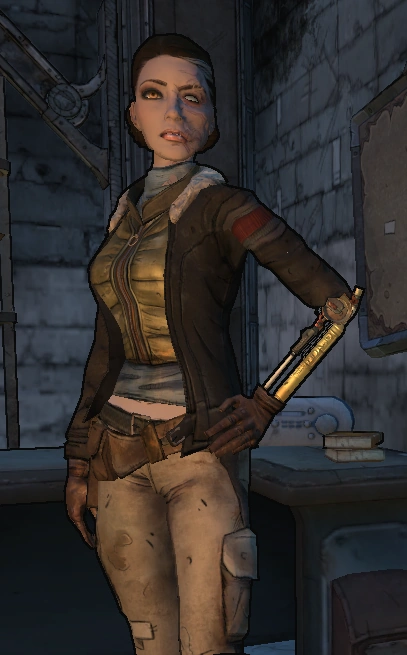
He seem's unreal, however. Up until now all I've told you, he is completely one dimentional. He wants to kill everyone because he's a sad ol' fart. But that's where Angel comes into it. Angel is Jack's Daughter, the daughter who he has a really confused relationship with. He is extremely abusive to her at first glance, even wishing for her own death in the end. He used her for her power, without getting too into detail, she was a very important, very powerful person, a Siren. He straps her into a machine and makes her do his bidding. However it wasn't as simple as that, he still loved her, he was still human. He had this one humbling moment where he loses his voice. He loses his composure and he break's down, almost crying, begging you to leave his daughter alone, as she is asking you to put her out of her misery. This was crucial for grounding Jack, making him a real believable person, not just a video game character.
These, are some of the things that make Handsome Jack such an amazing villain. We really get to know the guy, we could write an autobiography of his life. We know him to be a truly horrific person, but crucially he is still very much a person with his own thoughts and feelings, motivation's and emotions. He isn't perfect, like normal people, he has flaw's. This is a by product of Borderlands 2's amazing character writer's, we see these strength's in all the character's on Pandora, and one of the things I couldn't praise the game on highly enough.
19 July 2017
Video Game's: A history
Video games might not have been around for a particularly long time, but technology has advanced very rapidly, very aggressively, and a lot has happened since their conception. In this article, I want to discuss some of the history of video game's, putting a little extra focus on two of the more tragic tales of the industry: Nintendo, and EA Games.
Computers haven't always been capable of running games, in the early days games were only capable of batch processing. You give them an equation, then they freeze until it's over and return the answer. Sure you could make game's with this, there was a chess simulation some university programmed in research, but it wasn't very practical. You'd still be better off just using a chess set. however the invention of RAM, Random Access Memory, which allowed computers to store data while it worked, and allowed for real time processing. This, was what gaming needed to truly become an interactive medium. With this, people started experimenting with game's, mostly unsuccessfully. The first game to have any sort of influence, was a game you're probably familiar with, Pong. This game sparked the era or arcade game's, more and more were produced, full on arcade's were built, the industry was still taking it's baby steps, but it was a hit.
As the technology advanced, it got smaller and easier to pack into a home, the Magnavox Odyssey lead the charge as the first home console on the market, however it was quickly taken over by competitor's. Technology was moving fast, too fast to keep track of. It wasn't like today where a console last's nearly a decade, every few months something else was taking the place as best console. And with all that development and progress, came an over saturation of the market.
What ended up happening, is there was hundred's of different console's each with a couple game's on them, for dirt cheap on the market, and not worth a penny either way. This was absolutely tragic for the industry, it was label'd the video games crash of 1983. The recently booming video game industry, was valued at just over $100 a 97% drop in value from what it was originally worth, Gaming seemed doomed! And to make matter's worse, we didn't have a clue what was going wrong, why all of a sudden our amazing new industry was failing us, so we kept on trying, bringing out more console's, more games for those new consoles, and making the problem worse by the minute. Enter the savior, Nintendo. Nintendo knew how to fix our problem.They made a console, the NES, just like all these other companies, except while all these other companies were trying to focus on the hardware of their console's, nintendo focused instead on the game's. They pushed out a few high quality game's, for people of different demographics, so that the NES would actually by worth buying. People did, the NES was a huge hit globally, people learned from nintendo and most of the console companies died out, those who remained followed that model of fewer consoles and more games.
So everything's wonderful right? We're out of our recession, the gaming industry isn't borderline bankrupt again, things's should be perfect? Well, not quite. There were still a fair few issues that needed to be iron'd out before hand, almost all of them revolving around publishers. So the only way to get games onto a console were to have the console approve them and out them on your console. They didn't have the time or mean's to do that for literally everyone, so they entrusted publishers to represent their best interest's. Now these publisher's had way too much power and control, even more than they do now (and that's saying something.) they all treated their employee's like shit, no right's, no union's, you didn't like it, you got sacked. Eventually, everyone had had just about enough of it all, so when Trip Hawkins, founder of EA games offered them great salaries and contracts, getting things like credit in game. They lept at the opportunity! For a time, everything worth playing, was published by them, and all the other companies had to follow zuit else they lose their dev's! One thing that will stick with me, when they were deciding on the name, they started with Electronic Artist's, but Trip didn't like that name. He said "We're not the artist's, they are..." talking about the developer's under them. The packaging he used, the classic square case you use for music, were also EA's idea, because they wanted their developers to be portrayed as rockstar's.
Unfortunately, this prosperity wasn't to last. just under a decade and a half later, EA's CEO left and his replacement ran it into the penny grabbing pit of dodgy business practice's we know today, charging $100 for a full game through DLC and Microtransactions. Of course because EA could get away with it, everyone else could take that as there cue to follow suit and start treating their employee's with no respect, after they done so much to fix that problem already. We gave nintendo so much forgiveness when they were building their brand because of the good Nintendo America and some of Japan was doing, but with them it's 1 step forward 2 steps back. Embracing their community, then DMCA striking youtubers. Providing merchandise for cheap, then destroying fan games. It's terrible seeing these iconic figure's who saved gaming in their own right's, turn around and rule over it with an iron fist. Looking forward, EA seems to have found it's roots again and is starting to treat their developers and customers right, and Nintendo America has been trying to resolve the issues with Nintendo for quite a while now. All we can hope, is that it's enough to get us back on the right track.
Computers haven't always been capable of running games, in the early days games were only capable of batch processing. You give them an equation, then they freeze until it's over and return the answer. Sure you could make game's with this, there was a chess simulation some university programmed in research, but it wasn't very practical. You'd still be better off just using a chess set. however the invention of RAM, Random Access Memory, which allowed computers to store data while it worked, and allowed for real time processing. This, was what gaming needed to truly become an interactive medium. With this, people started experimenting with game's, mostly unsuccessfully. The first game to have any sort of influence, was a game you're probably familiar with, Pong. This game sparked the era or arcade game's, more and more were produced, full on arcade's were built, the industry was still taking it's baby steps, but it was a hit.
As the technology advanced, it got smaller and easier to pack into a home, the Magnavox Odyssey lead the charge as the first home console on the market, however it was quickly taken over by competitor's. Technology was moving fast, too fast to keep track of. It wasn't like today where a console last's nearly a decade, every few months something else was taking the place as best console. And with all that development and progress, came an over saturation of the market.
What ended up happening, is there was hundred's of different console's each with a couple game's on them, for dirt cheap on the market, and not worth a penny either way. This was absolutely tragic for the industry, it was label'd the video games crash of 1983. The recently booming video game industry, was valued at just over $100 a 97% drop in value from what it was originally worth, Gaming seemed doomed! And to make matter's worse, we didn't have a clue what was going wrong, why all of a sudden our amazing new industry was failing us, so we kept on trying, bringing out more console's, more games for those new consoles, and making the problem worse by the minute. Enter the savior, Nintendo. Nintendo knew how to fix our problem.They made a console, the NES, just like all these other companies, except while all these other companies were trying to focus on the hardware of their console's, nintendo focused instead on the game's. They pushed out a few high quality game's, for people of different demographics, so that the NES would actually by worth buying. People did, the NES was a huge hit globally, people learned from nintendo and most of the console companies died out, those who remained followed that model of fewer consoles and more games.
So everything's wonderful right? We're out of our recession, the gaming industry isn't borderline bankrupt again, things's should be perfect? Well, not quite. There were still a fair few issues that needed to be iron'd out before hand, almost all of them revolving around publishers. So the only way to get games onto a console were to have the console approve them and out them on your console. They didn't have the time or mean's to do that for literally everyone, so they entrusted publishers to represent their best interest's. Now these publisher's had way too much power and control, even more than they do now (and that's saying something.) they all treated their employee's like shit, no right's, no union's, you didn't like it, you got sacked. Eventually, everyone had had just about enough of it all, so when Trip Hawkins, founder of EA games offered them great salaries and contracts, getting things like credit in game. They lept at the opportunity! For a time, everything worth playing, was published by them, and all the other companies had to follow zuit else they lose their dev's! One thing that will stick with me, when they were deciding on the name, they started with Electronic Artist's, but Trip didn't like that name. He said "We're not the artist's, they are..." talking about the developer's under them. The packaging he used, the classic square case you use for music, were also EA's idea, because they wanted their developers to be portrayed as rockstar's.
Unfortunately, this prosperity wasn't to last. just under a decade and a half later, EA's CEO left and his replacement ran it into the penny grabbing pit of dodgy business practice's we know today, charging $100 for a full game through DLC and Microtransactions. Of course because EA could get away with it, everyone else could take that as there cue to follow suit and start treating their employee's with no respect, after they done so much to fix that problem already. We gave nintendo so much forgiveness when they were building their brand because of the good Nintendo America and some of Japan was doing, but with them it's 1 step forward 2 steps back. Embracing their community, then DMCA striking youtubers. Providing merchandise for cheap, then destroying fan games. It's terrible seeing these iconic figure's who saved gaming in their own right's, turn around and rule over it with an iron fist. Looking forward, EA seems to have found it's roots again and is starting to treat their developers and customers right, and Nintendo America has been trying to resolve the issues with Nintendo for quite a while now. All we can hope, is that it's enough to get us back on the right track.
14 July 2017
Daily mission's, a games design trap?
Daily Mission's or Quest's have been a big part of gaming for a very long time now. When they were conceived, they were originally praised for being a great way to make a player habitual, even if it's only brief, so they never truly take a break from the game. However as the years have gone by, the subject has gotten muddier and muddier, where some can argue that there are more problems it causes than fixes. In this article, I aim to explore this gaming phenomenon, and discuss whether they're still a tool that people want in their development arsenal, or not.
The pro's to a system like these, similar to login rewards, are that it encourages players to at least make some effort towards playing the game every single day. It rewards them for loyalty to their product, and more free stuff for loyal players is obviously good incentive for players to stick around. If you didn't change your playing habits at all, you would see you getting more stuff.
However, many would argue this is a very idealistic view, and practically doesn't have any of the same effects. I conducted a study playing League of Legends, where I asked a few questions to ~100 Co-op vs AI players, this showed me that over as many as 85% of the people I was matched with, were only playing AI to finish their quests for the night. They never played co-op vs AI normally, the question to ask is whether they wanted to play League in the first place, or they were treating it as a job. Doing what they "have" to do, to remain efficient. Another great example that I am familiar with, is Hearthstone. a card game where you have two option's. Try to play everyday and use your meagre gold gain to fund a small collection,or give them money. A lot of free to play players constantly complain that they don't like where the meta is right now, they just play to gain gold for the next upcoming expansion. Is this really the audience you want for your game?
I would argue creating this kind of culture will artificially create players, however when they catch on that they aren't enjoying the game any more, they will stop, find some competition, they will tell their friends, and then your player base starts to dwindle. You can no longer trust your metrics, "this is the most players we've had yet, surely that means the game is at it's best right now, right?" Because of this it makes the game harder to fix. The feedback that would normally be there for you to draw from, isn't there any more, and from there it becomes more and more of an impossible task, leading unfortunately to the death of the game and the community with it.
Personally, I think we'd be better off in a world without them. Video Game Addiction is worth mentioning in a topic like this, this kind of environment is where it thrives. Where people feel like they are being productive playing these game's instead of searching for jobs, or doing their schoolwork. In conclusion, to answer the question in the beginning, I do think daily missions or quest's are a trap that lots of developers don't understand how to use fully. Whilst it is a tool that has potential, I feel it is best avoided unless you are comfortable making it work.
The pro's to a system like these, similar to login rewards, are that it encourages players to at least make some effort towards playing the game every single day. It rewards them for loyalty to their product, and more free stuff for loyal players is obviously good incentive for players to stick around. If you didn't change your playing habits at all, you would see you getting more stuff.
However, many would argue this is a very idealistic view, and practically doesn't have any of the same effects. I conducted a study playing League of Legends, where I asked a few questions to ~100 Co-op vs AI players, this showed me that over as many as 85% of the people I was matched with, were only playing AI to finish their quests for the night. They never played co-op vs AI normally, the question to ask is whether they wanted to play League in the first place, or they were treating it as a job. Doing what they "have" to do, to remain efficient. Another great example that I am familiar with, is Hearthstone. a card game where you have two option's. Try to play everyday and use your meagre gold gain to fund a small collection,or give them money. A lot of free to play players constantly complain that they don't like where the meta is right now, they just play to gain gold for the next upcoming expansion. Is this really the audience you want for your game?
I would argue creating this kind of culture will artificially create players, however when they catch on that they aren't enjoying the game any more, they will stop, find some competition, they will tell their friends, and then your player base starts to dwindle. You can no longer trust your metrics, "this is the most players we've had yet, surely that means the game is at it's best right now, right?" Because of this it makes the game harder to fix. The feedback that would normally be there for you to draw from, isn't there any more, and from there it becomes more and more of an impossible task, leading unfortunately to the death of the game and the community with it.
Personally, I think we'd be better off in a world without them. Video Game Addiction is worth mentioning in a topic like this, this kind of environment is where it thrives. Where people feel like they are being productive playing these game's instead of searching for jobs, or doing their schoolwork. In conclusion, to answer the question in the beginning, I do think daily missions or quest's are a trap that lots of developers don't understand how to use fully. Whilst it is a tool that has potential, I feel it is best avoided unless you are comfortable making it work.
12 July 2017
Child of Light: Textual Analysis
This isn't necessarily college work, I just got bored over the holidays.

I didn't have much to do over half term, and I had £10 in the bank so I decided to find a game that looked cool, something I could play over a couple days and analyse for the rest of the week so looking for something fairly unique and amazing, I decided to pick up the game Child of Light. It is an eastern style Role-Playing Game developed and published by Ubisoft games. Based in a multi-layered two dimensional world with a simple linear with freedom narrative structure, and following A Dramatica character structure and classic 'Hero's Journey' story structure. They have expressed story through dialogue, texts and cut scenes, all of which are in rhymes. The art style is very artistic and drawn in water colours, as though the whole world has been painted in real life and scanned into the game. The music is a mix between a more powerful orchestral piece, and Lily Ki's Piano music which I will talk about later. But this is just a brief summary of the game, I hope that during this analysis I will expand on these points and showcase them in greater detail. But for now, what is it really?
Well it's a game, Very pretty with a gorgeous world to look at with really interesting, well thought-out characters. The music is sublimely composed and the Lyric work of the poetry is deep and meaningful, without being too over the top and crazy. I like a lot of things about how this game is executed, because it has this air of artistry about it that encourages a deeper thought amongst the player, it almost forces you to analyse the game and rewards you very well for doing so. On top of that there is an awful lot the game has to offer for me to talk about which I will touch on during this analysis.
I chose to analyse this game for a few reasons, firstly because it is very unique in the way it presents itself, I can't think of another game that uses this art style or the rhyming dialogue, or whatever. It has a lot going for it that separates it from other games, and that fascinates me that there are still game idea's out there that are still unique, that are still original and fresh. Yet it also show's repeated conventions from the genre, very stereotypical elements and aspects which make the game feel reminiscent from games like it that we may have played before. We don't need to learn what does what because most of it is implanted in the average consumers head from when they played other eastern RPG's before it. I've heard this story before and the game mechanics aren't really new to me. Though they will be new to people being introduced to the genre, majority of people will already be able to piece the game together like a scrap book of games they played before. In fact there was a talk a short while back that jumps to my attention when I think of this game called "Originality Complex" by Nika Harper, a favored writer of mine. (Found here: http://youtu.be/a-j4MMPQe_8?t=17s) In it she starts saying that everything has already happened, we have heard every story somewhere, we know of every character somehow. "It's all been done before" however, while this game might have things taken from other mediums and media texts, it is still unique because of the way they have been put together. This can be a very good message to send to young developers in the media industries as I found last year when I was doing games development, coming up with work that hasn't been done before is difficult and in a lot of cases not even possible. Try making a first person shooter game that is completely original and shares nothing with other games, you quickly find making a world and characters in extremely challenging, and designing all new mechanics is damn right impossible. So sending this message that it doesn't need to be 100% original to be a great idea. That "Some stories bear repeating." is a wonderful message to be spreading.
The Eastern Role-Playing genre (or JRPG for short) is a game where you are thrown into a whole new world and given a quest, often with a bunch of side quests on the side to lengthen the game time. The game is also a minor cross with 2D platformers and shares a lot of conventions with both genre's which I will talk about now. In these next few paragraphs I will be mentioning several other JRPG's:
Pokémon, a game where you essentially capture wild animals and make them fight other animals (But it's ok because they seem to enjoy it) to become the ultimate cock-fighting er I mean Pokémon master!
Final Fantasy, a game very similar to this game, it has a turn based combat system and it's you and your party of friends against whoever evil antagonist is at the time.
Castlevania, while not a traditional JRPG like the other games, this 2D platformer shares a lot of mechanics with Child of light outside combat.
These games share a lot on common, Pokémon and Final fantasy share almost identical combat mechanics, both utilise a turn-based combat system, both have similar stat pages aging back to games like DnD, both utilise randomness and percentages and 'dice-rolls' to determine outcomes of things happening (30% dodge chance. deals 1D8+whatever of damage, etc.) both have a form of party system where you can decide who you fight with, and quite a lot more similarities that I won't go too far into. It should come to no surprise that Child of Light has taken these mechanics for itself. They are all very traditional, conventional mechanics among JRPG's and this leaves a feeling of reminiscence and familiarity with the player. Fans of the genre will already know what is going on having played games like it in the past, to them this turn based system will feel completely natural to them. This turn based combat system is also commonly praised for being easy to learn but hard to master. Dynamically there isn't much skill involved, as it is a 50-50 split between a Luck base and a knowledge base. This means you don't need to learn all these advanced combat techniques and everything is based on your decisions, however the game also has a Random Number Generator (or RNG for short) to stop the game being boring and bring a sense of replayability to the game. This can also help bring characters to life as you play more and more in a sort of strange way. This is prevalent in a lot of chance based games, Dungeons and Dragons, Fire Emblem, Warhammer, War-Machine, etc. As you play with certaon characters or even dice, you begin getting attached to them. A dice physically is just a shape with numbered faces, but when you play for more and more you begin to pick out dice that always seem to give you lucky rolls, you begin to notice which dice screw you over with bad rolls. There is a video about this connection found here: https://www.youtube.com/watch?v=z4ZLqCIG4ZM and the author, Dodger, highlights that it's not just a dice, you develop connections with your dice and then they become much more than that. It's the same case with your party members or characters in other games. I remember back in the day's I played Warhammer there was this one model I called 'Zappitz da mek' who was renowned for his oversized gun being bigger than he was. The rules for him is that this gun had a myriad of settings which were chosen randomly by rolling 2, 6 sided dice. He was renowned for having this gun blow up in his face, except when he really needs it when he would come up big and roll double 6 killing everything. He developed a personality, he developed renown for himself. Going back to my original point, this is the reason adding a luck factor to a game is a great idea, and it is why it is such a staple in JRPG's today.
However these games aren't purely based on luck, there is also a large element of knowledge in them too. Knowledge of matchup's, knowledge of combo's, etc. It is what separates the first time JRPGers from the veterans of the genre. They will be able to see a few turns into the future and adapt his tactics to that. This is also great because it adds a feeling of challenge to the game. If it was as simple as mashing a single action for the entirety of the game, it would get boring quickly. You can make the game harder by increasing how much tactical knowledge is required to beat it, it’s this that separates Pokémon from Final fantasy. Pokémon is much simpler than Final Fantasy, and while it's still a great game, majority of Pokémon players don't necessarily play it for a challenge like they do with some other JRPG's. On top of this, adding mechanics like this also encourages a sense of research and helps increase the length and size of the game. It could just tell you fire attacks are strong against bug Pokémon, or it could let you work it out for yourself. A good example of this is a game called 'Yugioh: Capsule Monsters' where it tells you from the very beginning that standing in certain area is good for some elemental types, and bad for others. It tells you some elemental types are strong against other types and it gives you all the information you need at the very beginning. Needless to say I powered through the game in a couple hours, there was nothing for me to need to research or find out and the experience wasn't that fulfilling for me however I could see how it would be great for beginners and people new to the JRPG scene. On the polar opposite end of the scale there this game called Resonance of Fate which although I enjoyed playing it when I had it all figured out, was so complex and with so little instruction that you often felt cheated. Because of this it is great to find a middle ground where there is still stuff to find out, but it isn’t the entire experience.
Child of Light has also taken mechanics from the Castlevania franchise, mainly in the way we see and experience the world. Castlevania is a 2D platform game with a series of interconnected rooms and levels creating the world in which you play in. Often with secrets and hidden treasure hiding in various areas when you visit an area it will appear on your map showing doors and potential areas you might need to go. This is a great way to experience the world as it subconsciously plants thoughts of exploration and "I wonder what I may have missed over there." In fact quite a lot of the game is often locked to players who don't fully explore and pick up that key item somewhere in an earlier level. In Portrait of Ruin you can't progress unless you go back to one of the first levels when you are have the power to fly and grab a certain item of importance. Dawn of Sorrow, unless you explore the demon guest house and beat the boss there you are missing out on 3-4 areas and don't get the true ending.
Child of Light is a mainly knowledge based game, only delving into the luck mechanics occasionally and usually offering a "safe option" where you can try your luck and hope for that 30% dodge and take a swing, or defend and wait out their attack. The only real RNG we can't back out of is critical hits where both sides have a chance to get lucky and hit twice as hard for a turn. This is good because it almost forces your hand to adapt on the spot, if your guy gets crit down to next to no HP you have got to respect that and heal them back up, or you will probably lose your character next turn. This is good in that it adds another skill that you need to learn and gives you more variety in gameplay, you can't just spam an attack and hope all will be fine because you will probably lose a lot and give up. This game also utilises a 'Party' system that allows different players to have different strategies and provide more re-playability and gameplay variety. On top of that it also gives people something to talk about regarding the game, this is like free advertising because you're helping spread the word about "This awesome new game you're playing". It also helps extend the life of the game because you may want to try this strategy your friend told you about, or vice versa. As I mentioned it also taken a page out of Castlevania's book and have loads of hidden items and chests and stuff. Things for you to find, things for you to do and it greatly encourages you to explore every area in the game. Again this extends playtime and that’s a great thing. I've effectively finished the game at this point, I have beaten the final boss, reached the ending and experienced all the game can offer me, but I am still playing it to find those last few missing chests or to find that last page of lore. In the end however I can't see any messages or signs in the genre, so there isn't much I can talk about semiotically.
Child of Light had a very unique colourful graphics style everything about the game looks hand painted in water colours. There is a very symbolic use of colours throughout the game, you could often see water based enemies would use blues and bluey greens, fire based enemies would use reds and oranges, ect. Because they have used colour in this iconic way, we can immediately tell what is going on throughout the story. It makes sense that in a dark area where there are lots of blacks and dark greys, the enemies would be weak to light attacks. In a very green/brown area, it makes sense that you will need fire attacks to progress. This is important because it allows you to prepare for the enemies ahead simply by looking at the world around you. and in a game where it doesn't outright tell you what enemies are weak against what, they need to leave some sort of hint or clue that leads you towards the answer.
I am a huge fan of how the game has used a water coloured art style, it isn't often we see hugely artistic games anymore in the age of photo realistic graphics. It is a really nice change and it is what drew me to it in the first place. I am extremely fond of this approach because there is so much more that can be said with a hand crafted art style like this one. By using water colours and paints you add texture and more depth to a 2D world. You can also use a specialised art style to tell a message. I feel like they were trying to say this world was better than our own, a colourful world with much more personality than earth where everything is blacks whites and greys.
They have used a lot of very symbolic art when they made this game, and though I may not agree with the message it portrays, I can definitely see what the developers wanted to say and respect it is their story, not mine. It is a typical story of simple binary opposites. Life and death, good and evil, light and dark. However the design of the characters they have used to represent this is, for lack of a better work, quite racist or discriminatory. The good characters are portrayed as quite innocent and cute characters, looking at the main character we can see this tenfold in that she is a little girl, with long hair and bright colours. Her colour palette suggests innocence, faith and light in the whites and yellows, but with a hint of power and potential from her red hair. I have no problem with this, in fact I love how they have drawn her and she is a very inspiring character. However when we look towards to evil side of things is when I start to get a little concerned. Whether it was intended this way or not the evil characters and areas are shown in a very dark gothic style. And while yes I can see why they have chosen artwork like this, It might be seen as in the wrong light by people like myself who often dress up in gothic attire, and wear a lot of dark clothing and colours. I see the message that "Goth's" are potentially evil, selfish and corrupted, now again I doubt they meant it to be seen this way, fairies are also a large part of gothic folklore so it is possible they just envisioned it this way and the rest of the game was seen wrong, however what you mean to say and what you actually say are often two completely different things.
There have been other really artistic games in the past and will probably be in the future too. One of these games is a game called Limbo, a game which is purely in black, white and grey uses this very symbolical for how life and death can often be one and the same, and there is a fine line between them which is very easy to snap. The grey around us we don't notice, like the grey in real life not many people consider their surroundings. They could walk past a sign 100 times without realising it's there. It is great that games like this because there are much more interesting ways to tell a message than a statement or sign.
Something they actually somewhat broke the 4th wall on is when they actually mentioned some of the art in the game, things like the crown having "FAUX" Written along the inside of it, or the tears on Tristis' make up. They actually mention these in dialogue in game and bring them to your attention. I think this is because they wanted the player to think about it, and start considering the messages they left in the artwork. Things like Gen's face looking like she has marks under her eye's as though she was crying, they have left plenty for the player to find themselves and discover hidden in the background. We are coming to an age now where games are starting to hide these stories more and more, this "Tell them but don't tell them" storytelling technique is becoming drastically more common, with roots in games like this and Dark Souls. This technique relies on not necessarily leaving a note or message in plain sight, like a definite "This person is sleeping with that person" but rather by leaving this person's underwear in that person's house. This gives the game a lot more depth and life than could ever be accomplished by just outright telling them. This is a game after all, we are supposed to play the game not just read it.
I like the decision to keep the game in a 3rd person view-point, because it seems that ant other perspective would be unsuitable. Making it 3D would remove the beautiful artistic graphics I have just talked about, and if it was a 1st person game we would have the wrong relationship with the characters. We would be destroying a lot of the gameplay mechanics that makes this game unique and amazing. I think it's very important to take note of what perspective the game is played for the games storytelling too. You need to stick to certain rules when using these perspectives otherwise you risk breaking immersion with the player, and that can really hurt the narrative. For example if we take a game like Call of Duty, a game where the sole purpose of the game is to make you feel really powerful and important, you need to use a 1st person viewpoint at all times otherwise It’s not you being powerful and awesome, it's the protagonist instead. It's great that they used a third person perspective because this gives us a little distance from the character. We aren't playing as Aurora, we are playing with her. It allows is to view her as a character and learn more about the story than if she were an icon who we simply experienced the game from. We see her develop and grow throughout the game and without this perspective we wouldn't see that.
Music is another fairly large important theme throughout the game. The protagonist has this flute, she knows one song on it, and it's used to great effect as a big focal point for the story. We hear her song spreading joy and happiness throughout the game, and this is a great example of how music can be used as a set piece for the narrative. The soundtrack is also really good at messing with your emotions. During some of the calm town areas, the music is very relaxing and soothing. But during combat the music is very heavy and almost epic in a way. This is great because music is well known for its ability to play with emotions and subconsciously play with the listener. For example if you compare Dearly Beloved from http://picosong.com/fDkS/ with Hand of Blood here http://picosong.com/fDkN/ . Dearly Beloved is really calming and relaxing. it brings a smile to your face and everything seems to slow down around you. Yet there is also a hint of sadness in the music, a sense of longing like when you miss someone or something. In a very powerful contrast to this is the other song Hand of Blood which is a metal, screamo song. It's very active and fast with a lot going on at the same time. It brings a distinct energetic feeling, it makes you want to jump to your feet and go a little crazy. There is a distinct power music has over people and it is easily shown in these songs and this is present in Child of Lights soundtrack too. Although it isn't as amazingly powerful and memorable as say Dearly Beloved as I mentioned before, it is still very good music with a lot of control over the players experience.
The most dominant instruments I could hear in the OST were Piano's, Violins, and flute. There were others, but these were the ones I could always hear and made notes of. I like these choices because the instruments personalities tie together very well with the rest of the game. We typically would see these instruments as soft and calm, rather soothing and light. This fits with the theme of light very closely and emphasises the emotions the game is trying to portray. While it is also true that these instruments can be used in different ways such as Lindsey Stirling’s Violin work and a lot of Mozart’s piano work which is very up-beat and lively, it isn't that common to hear them played like this and it's generally best to take the more typical approach when thinking about it this way. This is because majority of people will hear them this way, so it is a safer option. I especially like the use of the flute because it also holds plot significance, It makes so much sense to include this instrument that not doing so would be just wrong, like missing the chocolate out of chocolate-cake.
The plot is pretty simple, and so copied from Wikipedia: Child of Light centers on Aurora, a girl from 1895 Austria who contracts a physical ailment that kills her. A protection spell cast by her mother causes Aurora to wake up on an altar in the mythical land of Lemuria. Lemuria has had its sun, moon and stars stolen by the Dark Queen, Umbra. Aurora is tasked with recovering the celestial bodies and ultimately reuniting with her father, who is a duke. Helped by her playable companion Igniculus the firefly and several unlikely allies, Aurora will face her darkest fears in this modern take on a coming-of-age story.
The story to me follows a Hero's Journey narrative structure, with a slight twist. The Ordinary World is where Aurora is in Austria, living her life as daughter to the duke. The Call to Adventure is when she dies in the human world and wakes up on the alter. The Refusal of the Call is the start to the game where she is scared and just wants to go home. The Meeting with the Mentor is when we free the Queen of Light from her prison in the old church. She Crosses the Threshold is when she flies out the top of the church with her new crown and wings. Test's Allies and Enemies is the story all the way up to the palace of the sun. The approach would be her getting ready to face Umbra and Nox. The Ordeal would be her beating Nox and the Reward, taking the sun from her. however it's here that the heroes journey stops fitting as we back up on ourselves. She gets ready to face umbra, but without the Faux Crown to protect her she gets hurt. This leads to the Resurrection where she is reborn at the alter with a true crown. There we go back to another ordeal as she fights Umbra and frees the land from the darkness. from there we go to the Road Back where she passes back through the magic mirror to the human world. Finally the Return with the Elixir where she saves the humans from her palace in Austria from a flood by pulling them back through with her into the World of Light. This is a good example of how you don't need to follow a narrative structure to the ltter, but it's better to adapt it to your needs. Child of Light also seems to follow the Dramatica Character Model. The Protagonist is obviously Aurora with her binary opposite being Umbra as the Antagonist, a Child of Light vs. a Child of Dark respectively. The Sidekick would be Igniculus the Firefly, constantly cheering Aurora on and giving her encouragement, The Skeptic would probably be Finn the wizard who is quite the opposite and not only doubts Aurora's ability to succeed, but also his own. The Emotional character, I think, would probably be Genovefa (Gen for short) who when we recruit her she is crying over the loss of her parents, and all throughout the game after that we see her showing lots of emotion and character. The reasoner... it's tough to say. I'd probably say Óengus is the reasoner as he can appear to be a rather cold character who is always thinking logically. The guardian was clearly the Queen of Light who was guarding and protecting her since the very beginning. Contagonist was Nox who was only pretending to be her friend but was secretly working for Umbra (Interestingly she doesn't exactly want to hurt Aurora, just convert her to her way of thinking and suck the light out of her). It is good they used this model because it is almost designed to create conflict and story amidst friends and enemies. by having characters Binary Opposites of each other they are almost certain to disagree with each other at times, creating conflict. and conflict = good storytelling.
Speaking of storytelling Child of light has used several techniques to tell the story in an interesting way, mainly through dialogue, cut scenes and little poems called "Confessions" Detailing the little stories in the game. I'll start with the dialogue, there is lots and LOTS of it. Dialogue between your friends as they all get to know eachother a little, dialogue between Aurora and some of the key characters driving the narrative forward or telling what you're supposed to do, loads of it and it has been used really well throughout the game. You get a clear sense of character playing the game like the characters are real people and not just a waveform through a speaker. That being said I think more important than when they have used dialogue to good effect, is when they haven't used dialogue, to good effect. Let me elaborate on that, what I mean is when they held the dialogue back and let the scene tell itself. One scene in particular comes to mind, the scene where we recruit Gen to our party. http://www.youtube.com/watch?v=UQHaM7WWTlw In this scene no dialogue would be able to say what we wanted to say, there isn't a word in English to portray the right emotions during this shot.
Aurora: "Your parents are dead"
Gen : "Oh no, I am so sad. what should I do?"
Aurora: "Come with us, get revenge"
Gen : "ok"
It just doesn't have the same effect as just leaving it wordless and showing us what is happening like this. This is a very powerful use of Dialogue, simply by not being very dialogue heavy. there is a phrase which we are constantly told in games development "Show, don't tell." This is very VERY important in good story writing because there is no immersion, emotion or feeling in "I am sad" There is just nothing there. it is boring writing and if your entire book is written like that you might as well put it through a shredder and sell the scraps. Instead you should write something that helps the reader envision it to make the player experience it. Something along the lines of "I ran. With tears in my eyes, I ran and ran and ran. too heartbroken to look back." Its things like this that separates good writers from bad ones and it's something this game does amazingly.
To me this seems like your average fairy tale, you could probably compare this to stories like Little Red Riding Hood and Snow White and show great comparisons. However with that comes the curse that it shares the same overall message as them too. good versus evil, good always wins. However although this message may have been told a thousand times before, this goes back to the video I linked at the start, Originality Complex by Nika Harper. "Repeat the good lesson's we've learned, because someone hasn't heard them yet." I hadn't really thought about these messages before now but it's completely true. Every time we see this message in real life, good versus evil, it's all just a matter of perspective as to who is who. To the people in Isis, they are the good guys, to the people they are beheading they are evil. To the Germans in WWII Hitler was a great man, to everyone else he was evil. Now if Germany won WWII we would live in a world he ruled. He would be the good guy for beating the world and spreading his vision to everybody else. If ISIS win then we will most likely all be dead, so who would be alive to call them a bad guy? They will be the good guy in everyone’s eyes. Good always wins, even if they aren't the good guy to begin with. Another good historical example of this would be the romans. They invaded Britain and brought their culture with them, we built on that and call the romans hero's for building us to who we are today and providing a base for us to grow. However to the Celts and Scots who died to their invasion the romans were evil, invading the land and eviscerating their culture. It's a very interesting message with a lot more background than I originally thought about.
So is that really what it is? I think so. I really like this game and think it's a really amazing, heavily inspirational game that I am really glad I got the chance to talk about. I know this analysis is a little short, there are plenty more things I would like to talk about after this, but they are all minor details and tiny extra's that make just make the game feel a little more fleshy and less hollow. And with college looming around the corner I feel I should end it here, I've talked about enough. I feel this game is going to have a huge impact on a lot of my work, both personal projects and my professional paid animation work. and here's to more work this cool.
I didn't have much to do over half term, and I had £10 in the bank so I decided to find a game that looked cool, something I could play over a couple days and analyse for the rest of the week so looking for something fairly unique and amazing, I decided to pick up the game Child of Light. It is an eastern style Role-Playing Game developed and published by Ubisoft games. Based in a multi-layered two dimensional world with a simple linear with freedom narrative structure, and following A Dramatica character structure and classic 'Hero's Journey' story structure. They have expressed story through dialogue, texts and cut scenes, all of which are in rhymes. The art style is very artistic and drawn in water colours, as though the whole world has been painted in real life and scanned into the game. The music is a mix between a more powerful orchestral piece, and Lily Ki's Piano music which I will talk about later. But this is just a brief summary of the game, I hope that during this analysis I will expand on these points and showcase them in greater detail. But for now, what is it really?
Well it's a game, Very pretty with a gorgeous world to look at with really interesting, well thought-out characters. The music is sublimely composed and the Lyric work of the poetry is deep and meaningful, without being too over the top and crazy. I like a lot of things about how this game is executed, because it has this air of artistry about it that encourages a deeper thought amongst the player, it almost forces you to analyse the game and rewards you very well for doing so. On top of that there is an awful lot the game has to offer for me to talk about which I will touch on during this analysis.
I chose to analyse this game for a few reasons, firstly because it is very unique in the way it presents itself, I can't think of another game that uses this art style or the rhyming dialogue, or whatever. It has a lot going for it that separates it from other games, and that fascinates me that there are still game idea's out there that are still unique, that are still original and fresh. Yet it also show's repeated conventions from the genre, very stereotypical elements and aspects which make the game feel reminiscent from games like it that we may have played before. We don't need to learn what does what because most of it is implanted in the average consumers head from when they played other eastern RPG's before it. I've heard this story before and the game mechanics aren't really new to me. Though they will be new to people being introduced to the genre, majority of people will already be able to piece the game together like a scrap book of games they played before. In fact there was a talk a short while back that jumps to my attention when I think of this game called "Originality Complex" by Nika Harper, a favored writer of mine. (Found here: http://youtu.be/a-j4MMPQe_8?t=17s) In it she starts saying that everything has already happened, we have heard every story somewhere, we know of every character somehow. "It's all been done before" however, while this game might have things taken from other mediums and media texts, it is still unique because of the way they have been put together. This can be a very good message to send to young developers in the media industries as I found last year when I was doing games development, coming up with work that hasn't been done before is difficult and in a lot of cases not even possible. Try making a first person shooter game that is completely original and shares nothing with other games, you quickly find making a world and characters in extremely challenging, and designing all new mechanics is damn right impossible. So sending this message that it doesn't need to be 100% original to be a great idea. That "Some stories bear repeating." is a wonderful message to be spreading.
The Eastern Role-Playing genre (or JRPG for short) is a game where you are thrown into a whole new world and given a quest, often with a bunch of side quests on the side to lengthen the game time. The game is also a minor cross with 2D platformers and shares a lot of conventions with both genre's which I will talk about now. In these next few paragraphs I will be mentioning several other JRPG's:
Pokémon, a game where you essentially capture wild animals and make them fight other animals (But it's ok because they seem to enjoy it) to become the ultimate cock-fighting er I mean Pokémon master!
Final Fantasy, a game very similar to this game, it has a turn based combat system and it's you and your party of friends against whoever evil antagonist is at the time.
Castlevania, while not a traditional JRPG like the other games, this 2D platformer shares a lot of mechanics with Child of light outside combat.
These games share a lot on common, Pokémon and Final fantasy share almost identical combat mechanics, both utilise a turn-based combat system, both have similar stat pages aging back to games like DnD, both utilise randomness and percentages and 'dice-rolls' to determine outcomes of things happening (30% dodge chance. deals 1D8+whatever of damage, etc.) both have a form of party system where you can decide who you fight with, and quite a lot more similarities that I won't go too far into. It should come to no surprise that Child of Light has taken these mechanics for itself. They are all very traditional, conventional mechanics among JRPG's and this leaves a feeling of reminiscence and familiarity with the player. Fans of the genre will already know what is going on having played games like it in the past, to them this turn based system will feel completely natural to them. This turn based combat system is also commonly praised for being easy to learn but hard to master. Dynamically there isn't much skill involved, as it is a 50-50 split between a Luck base and a knowledge base. This means you don't need to learn all these advanced combat techniques and everything is based on your decisions, however the game also has a Random Number Generator (or RNG for short) to stop the game being boring and bring a sense of replayability to the game. This can also help bring characters to life as you play more and more in a sort of strange way. This is prevalent in a lot of chance based games, Dungeons and Dragons, Fire Emblem, Warhammer, War-Machine, etc. As you play with certaon characters or even dice, you begin getting attached to them. A dice physically is just a shape with numbered faces, but when you play for more and more you begin to pick out dice that always seem to give you lucky rolls, you begin to notice which dice screw you over with bad rolls. There is a video about this connection found here: https://www.youtube.com/watch?v=z4ZLqCIG4ZM and the author, Dodger, highlights that it's not just a dice, you develop connections with your dice and then they become much more than that. It's the same case with your party members or characters in other games. I remember back in the day's I played Warhammer there was this one model I called 'Zappitz da mek' who was renowned for his oversized gun being bigger than he was. The rules for him is that this gun had a myriad of settings which were chosen randomly by rolling 2, 6 sided dice. He was renowned for having this gun blow up in his face, except when he really needs it when he would come up big and roll double 6 killing everything. He developed a personality, he developed renown for himself. Going back to my original point, this is the reason adding a luck factor to a game is a great idea, and it is why it is such a staple in JRPG's today.
However these games aren't purely based on luck, there is also a large element of knowledge in them too. Knowledge of matchup's, knowledge of combo's, etc. It is what separates the first time JRPGers from the veterans of the genre. They will be able to see a few turns into the future and adapt his tactics to that. This is also great because it adds a feeling of challenge to the game. If it was as simple as mashing a single action for the entirety of the game, it would get boring quickly. You can make the game harder by increasing how much tactical knowledge is required to beat it, it’s this that separates Pokémon from Final fantasy. Pokémon is much simpler than Final Fantasy, and while it's still a great game, majority of Pokémon players don't necessarily play it for a challenge like they do with some other JRPG's. On top of this, adding mechanics like this also encourages a sense of research and helps increase the length and size of the game. It could just tell you fire attacks are strong against bug Pokémon, or it could let you work it out for yourself. A good example of this is a game called 'Yugioh: Capsule Monsters' where it tells you from the very beginning that standing in certain area is good for some elemental types, and bad for others. It tells you some elemental types are strong against other types and it gives you all the information you need at the very beginning. Needless to say I powered through the game in a couple hours, there was nothing for me to need to research or find out and the experience wasn't that fulfilling for me however I could see how it would be great for beginners and people new to the JRPG scene. On the polar opposite end of the scale there this game called Resonance of Fate which although I enjoyed playing it when I had it all figured out, was so complex and with so little instruction that you often felt cheated. Because of this it is great to find a middle ground where there is still stuff to find out, but it isn’t the entire experience.
Child of Light has also taken mechanics from the Castlevania franchise, mainly in the way we see and experience the world. Castlevania is a 2D platform game with a series of interconnected rooms and levels creating the world in which you play in. Often with secrets and hidden treasure hiding in various areas when you visit an area it will appear on your map showing doors and potential areas you might need to go. This is a great way to experience the world as it subconsciously plants thoughts of exploration and "I wonder what I may have missed over there." In fact quite a lot of the game is often locked to players who don't fully explore and pick up that key item somewhere in an earlier level. In Portrait of Ruin you can't progress unless you go back to one of the first levels when you are have the power to fly and grab a certain item of importance. Dawn of Sorrow, unless you explore the demon guest house and beat the boss there you are missing out on 3-4 areas and don't get the true ending.
Child of Light is a mainly knowledge based game, only delving into the luck mechanics occasionally and usually offering a "safe option" where you can try your luck and hope for that 30% dodge and take a swing, or defend and wait out their attack. The only real RNG we can't back out of is critical hits where both sides have a chance to get lucky and hit twice as hard for a turn. This is good because it almost forces your hand to adapt on the spot, if your guy gets crit down to next to no HP you have got to respect that and heal them back up, or you will probably lose your character next turn. This is good in that it adds another skill that you need to learn and gives you more variety in gameplay, you can't just spam an attack and hope all will be fine because you will probably lose a lot and give up. This game also utilises a 'Party' system that allows different players to have different strategies and provide more re-playability and gameplay variety. On top of that it also gives people something to talk about regarding the game, this is like free advertising because you're helping spread the word about "This awesome new game you're playing". It also helps extend the life of the game because you may want to try this strategy your friend told you about, or vice versa. As I mentioned it also taken a page out of Castlevania's book and have loads of hidden items and chests and stuff. Things for you to find, things for you to do and it greatly encourages you to explore every area in the game. Again this extends playtime and that’s a great thing. I've effectively finished the game at this point, I have beaten the final boss, reached the ending and experienced all the game can offer me, but I am still playing it to find those last few missing chests or to find that last page of lore. In the end however I can't see any messages or signs in the genre, so there isn't much I can talk about semiotically.
Child of Light had a very unique colourful graphics style everything about the game looks hand painted in water colours. There is a very symbolic use of colours throughout the game, you could often see water based enemies would use blues and bluey greens, fire based enemies would use reds and oranges, ect. Because they have used colour in this iconic way, we can immediately tell what is going on throughout the story. It makes sense that in a dark area where there are lots of blacks and dark greys, the enemies would be weak to light attacks. In a very green/brown area, it makes sense that you will need fire attacks to progress. This is important because it allows you to prepare for the enemies ahead simply by looking at the world around you. and in a game where it doesn't outright tell you what enemies are weak against what, they need to leave some sort of hint or clue that leads you towards the answer.
I am a huge fan of how the game has used a water coloured art style, it isn't often we see hugely artistic games anymore in the age of photo realistic graphics. It is a really nice change and it is what drew me to it in the first place. I am extremely fond of this approach because there is so much more that can be said with a hand crafted art style like this one. By using water colours and paints you add texture and more depth to a 2D world. You can also use a specialised art style to tell a message. I feel like they were trying to say this world was better than our own, a colourful world with much more personality than earth where everything is blacks whites and greys.
They have used a lot of very symbolic art when they made this game, and though I may not agree with the message it portrays, I can definitely see what the developers wanted to say and respect it is their story, not mine. It is a typical story of simple binary opposites. Life and death, good and evil, light and dark. However the design of the characters they have used to represent this is, for lack of a better work, quite racist or discriminatory. The good characters are portrayed as quite innocent and cute characters, looking at the main character we can see this tenfold in that she is a little girl, with long hair and bright colours. Her colour palette suggests innocence, faith and light in the whites and yellows, but with a hint of power and potential from her red hair. I have no problem with this, in fact I love how they have drawn her and she is a very inspiring character. However when we look towards to evil side of things is when I start to get a little concerned. Whether it was intended this way or not the evil characters and areas are shown in a very dark gothic style. And while yes I can see why they have chosen artwork like this, It might be seen as in the wrong light by people like myself who often dress up in gothic attire, and wear a lot of dark clothing and colours. I see the message that "Goth's" are potentially evil, selfish and corrupted, now again I doubt they meant it to be seen this way, fairies are also a large part of gothic folklore so it is possible they just envisioned it this way and the rest of the game was seen wrong, however what you mean to say and what you actually say are often two completely different things.
There have been other really artistic games in the past and will probably be in the future too. One of these games is a game called Limbo, a game which is purely in black, white and grey uses this very symbolical for how life and death can often be one and the same, and there is a fine line between them which is very easy to snap. The grey around us we don't notice, like the grey in real life not many people consider their surroundings. They could walk past a sign 100 times without realising it's there. It is great that games like this because there are much more interesting ways to tell a message than a statement or sign.
Something they actually somewhat broke the 4th wall on is when they actually mentioned some of the art in the game, things like the crown having "FAUX" Written along the inside of it, or the tears on Tristis' make up. They actually mention these in dialogue in game and bring them to your attention. I think this is because they wanted the player to think about it, and start considering the messages they left in the artwork. Things like Gen's face looking like she has marks under her eye's as though she was crying, they have left plenty for the player to find themselves and discover hidden in the background. We are coming to an age now where games are starting to hide these stories more and more, this "Tell them but don't tell them" storytelling technique is becoming drastically more common, with roots in games like this and Dark Souls. This technique relies on not necessarily leaving a note or message in plain sight, like a definite "This person is sleeping with that person" but rather by leaving this person's underwear in that person's house. This gives the game a lot more depth and life than could ever be accomplished by just outright telling them. This is a game after all, we are supposed to play the game not just read it.
I like the decision to keep the game in a 3rd person view-point, because it seems that ant other perspective would be unsuitable. Making it 3D would remove the beautiful artistic graphics I have just talked about, and if it was a 1st person game we would have the wrong relationship with the characters. We would be destroying a lot of the gameplay mechanics that makes this game unique and amazing. I think it's very important to take note of what perspective the game is played for the games storytelling too. You need to stick to certain rules when using these perspectives otherwise you risk breaking immersion with the player, and that can really hurt the narrative. For example if we take a game like Call of Duty, a game where the sole purpose of the game is to make you feel really powerful and important, you need to use a 1st person viewpoint at all times otherwise It’s not you being powerful and awesome, it's the protagonist instead. It's great that they used a third person perspective because this gives us a little distance from the character. We aren't playing as Aurora, we are playing with her. It allows is to view her as a character and learn more about the story than if she were an icon who we simply experienced the game from. We see her develop and grow throughout the game and without this perspective we wouldn't see that.
Music is another fairly large important theme throughout the game. The protagonist has this flute, she knows one song on it, and it's used to great effect as a big focal point for the story. We hear her song spreading joy and happiness throughout the game, and this is a great example of how music can be used as a set piece for the narrative. The soundtrack is also really good at messing with your emotions. During some of the calm town areas, the music is very relaxing and soothing. But during combat the music is very heavy and almost epic in a way. This is great because music is well known for its ability to play with emotions and subconsciously play with the listener. For example if you compare Dearly Beloved from http://picosong.com/fDkS/ with Hand of Blood here http://picosong.com/fDkN/ . Dearly Beloved is really calming and relaxing. it brings a smile to your face and everything seems to slow down around you. Yet there is also a hint of sadness in the music, a sense of longing like when you miss someone or something. In a very powerful contrast to this is the other song Hand of Blood which is a metal, screamo song. It's very active and fast with a lot going on at the same time. It brings a distinct energetic feeling, it makes you want to jump to your feet and go a little crazy. There is a distinct power music has over people and it is easily shown in these songs and this is present in Child of Lights soundtrack too. Although it isn't as amazingly powerful and memorable as say Dearly Beloved as I mentioned before, it is still very good music with a lot of control over the players experience.
The most dominant instruments I could hear in the OST were Piano's, Violins, and flute. There were others, but these were the ones I could always hear and made notes of. I like these choices because the instruments personalities tie together very well with the rest of the game. We typically would see these instruments as soft and calm, rather soothing and light. This fits with the theme of light very closely and emphasises the emotions the game is trying to portray. While it is also true that these instruments can be used in different ways such as Lindsey Stirling’s Violin work and a lot of Mozart’s piano work which is very up-beat and lively, it isn't that common to hear them played like this and it's generally best to take the more typical approach when thinking about it this way. This is because majority of people will hear them this way, so it is a safer option. I especially like the use of the flute because it also holds plot significance, It makes so much sense to include this instrument that not doing so would be just wrong, like missing the chocolate out of chocolate-cake.
The plot is pretty simple, and so copied from Wikipedia: Child of Light centers on Aurora, a girl from 1895 Austria who contracts a physical ailment that kills her. A protection spell cast by her mother causes Aurora to wake up on an altar in the mythical land of Lemuria. Lemuria has had its sun, moon and stars stolen by the Dark Queen, Umbra. Aurora is tasked with recovering the celestial bodies and ultimately reuniting with her father, who is a duke. Helped by her playable companion Igniculus the firefly and several unlikely allies, Aurora will face her darkest fears in this modern take on a coming-of-age story.
The story to me follows a Hero's Journey narrative structure, with a slight twist. The Ordinary World is where Aurora is in Austria, living her life as daughter to the duke. The Call to Adventure is when she dies in the human world and wakes up on the alter. The Refusal of the Call is the start to the game where she is scared and just wants to go home. The Meeting with the Mentor is when we free the Queen of Light from her prison in the old church. She Crosses the Threshold is when she flies out the top of the church with her new crown and wings. Test's Allies and Enemies is the story all the way up to the palace of the sun. The approach would be her getting ready to face Umbra and Nox. The Ordeal would be her beating Nox and the Reward, taking the sun from her. however it's here that the heroes journey stops fitting as we back up on ourselves. She gets ready to face umbra, but without the Faux Crown to protect her she gets hurt. This leads to the Resurrection where she is reborn at the alter with a true crown. There we go back to another ordeal as she fights Umbra and frees the land from the darkness. from there we go to the Road Back where she passes back through the magic mirror to the human world. Finally the Return with the Elixir where she saves the humans from her palace in Austria from a flood by pulling them back through with her into the World of Light. This is a good example of how you don't need to follow a narrative structure to the ltter, but it's better to adapt it to your needs. Child of Light also seems to follow the Dramatica Character Model. The Protagonist is obviously Aurora with her binary opposite being Umbra as the Antagonist, a Child of Light vs. a Child of Dark respectively. The Sidekick would be Igniculus the Firefly, constantly cheering Aurora on and giving her encouragement, The Skeptic would probably be Finn the wizard who is quite the opposite and not only doubts Aurora's ability to succeed, but also his own. The Emotional character, I think, would probably be Genovefa (Gen for short) who when we recruit her she is crying over the loss of her parents, and all throughout the game after that we see her showing lots of emotion and character. The reasoner... it's tough to say. I'd probably say Óengus is the reasoner as he can appear to be a rather cold character who is always thinking logically. The guardian was clearly the Queen of Light who was guarding and protecting her since the very beginning. Contagonist was Nox who was only pretending to be her friend but was secretly working for Umbra (Interestingly she doesn't exactly want to hurt Aurora, just convert her to her way of thinking and suck the light out of her). It is good they used this model because it is almost designed to create conflict and story amidst friends and enemies. by having characters Binary Opposites of each other they are almost certain to disagree with each other at times, creating conflict. and conflict = good storytelling.
Speaking of storytelling Child of light has used several techniques to tell the story in an interesting way, mainly through dialogue, cut scenes and little poems called "Confessions" Detailing the little stories in the game. I'll start with the dialogue, there is lots and LOTS of it. Dialogue between your friends as they all get to know eachother a little, dialogue between Aurora and some of the key characters driving the narrative forward or telling what you're supposed to do, loads of it and it has been used really well throughout the game. You get a clear sense of character playing the game like the characters are real people and not just a waveform through a speaker. That being said I think more important than when they have used dialogue to good effect, is when they haven't used dialogue, to good effect. Let me elaborate on that, what I mean is when they held the dialogue back and let the scene tell itself. One scene in particular comes to mind, the scene where we recruit Gen to our party. http://www.youtube.com/watch?v=UQHaM7WWTlw In this scene no dialogue would be able to say what we wanted to say, there isn't a word in English to portray the right emotions during this shot.
Aurora: "Your parents are dead"
Gen : "Oh no, I am so sad. what should I do?"
Aurora: "Come with us, get revenge"
Gen : "ok"
It just doesn't have the same effect as just leaving it wordless and showing us what is happening like this. This is a very powerful use of Dialogue, simply by not being very dialogue heavy. there is a phrase which we are constantly told in games development "Show, don't tell." This is very VERY important in good story writing because there is no immersion, emotion or feeling in "I am sad" There is just nothing there. it is boring writing and if your entire book is written like that you might as well put it through a shredder and sell the scraps. Instead you should write something that helps the reader envision it to make the player experience it. Something along the lines of "I ran. With tears in my eyes, I ran and ran and ran. too heartbroken to look back." Its things like this that separates good writers from bad ones and it's something this game does amazingly.
To me this seems like your average fairy tale, you could probably compare this to stories like Little Red Riding Hood and Snow White and show great comparisons. However with that comes the curse that it shares the same overall message as them too. good versus evil, good always wins. However although this message may have been told a thousand times before, this goes back to the video I linked at the start, Originality Complex by Nika Harper. "Repeat the good lesson's we've learned, because someone hasn't heard them yet." I hadn't really thought about these messages before now but it's completely true. Every time we see this message in real life, good versus evil, it's all just a matter of perspective as to who is who. To the people in Isis, they are the good guys, to the people they are beheading they are evil. To the Germans in WWII Hitler was a great man, to everyone else he was evil. Now if Germany won WWII we would live in a world he ruled. He would be the good guy for beating the world and spreading his vision to everybody else. If ISIS win then we will most likely all be dead, so who would be alive to call them a bad guy? They will be the good guy in everyone’s eyes. Good always wins, even if they aren't the good guy to begin with. Another good historical example of this would be the romans. They invaded Britain and brought their culture with them, we built on that and call the romans hero's for building us to who we are today and providing a base for us to grow. However to the Celts and Scots who died to their invasion the romans were evil, invading the land and eviscerating their culture. It's a very interesting message with a lot more background than I originally thought about.
So is that really what it is? I think so. I really like this game and think it's a really amazing, heavily inspirational game that I am really glad I got the chance to talk about. I know this analysis is a little short, there are plenty more things I would like to talk about after this, but they are all minor details and tiny extra's that make just make the game feel a little more fleshy and less hollow. And with college looming around the corner I feel I should end it here, I've talked about enough. I feel this game is going to have a huge impact on a lot of my work, both personal projects and my professional paid animation work. and here's to more work this cool.
Subscribe to:
Comments (Atom)